First the Diagnostic, then the right move.
Within two weeks we determine your company's maturity level, the most suitable business scenario and which horizon to start from, through a field + data study. The output is a written Diagnostic report; together with the analysis that supports the decision.
Two weeks.
- Week 1
Field + data discovery.
Stakeholder interviews (leadership, IT, operations, users)
Current workflow map and an inventory of existing AI use
Maturity measurement within the AI Momentum framework
Previous pilot and PoC records, where they exist
- Week 2
Analysis + recommendation.
Interpretation of the maturity score and benchmarking
Recommended horizon and its rationale
Selection of the priority business scenario
Risk inventory and duration estimate
Written Diagnostic report and presentation
The Diagnostic report.
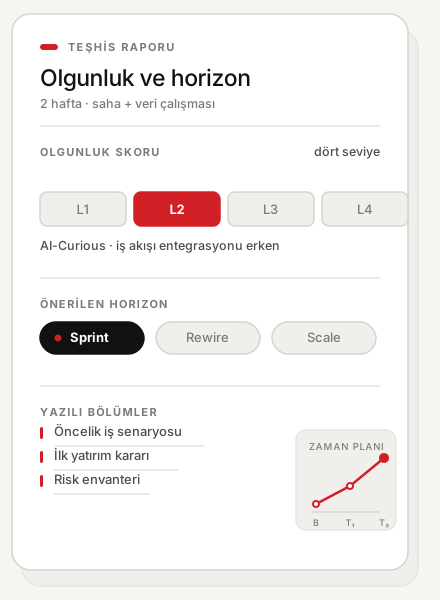
The output is a written report; six sections document the decision, from maturity score to timeline.
Maturity score
The company's AI maturity on a four-level scale; across individual use, workflow integration, measurement discipline and governance.
Recommended horizon
An Adoption Sprint, Workflow Rewire or Agentic Scale recommendation; with its rationale and the reasons the others were not chosen.
Priority business scenario
Which process to start in, with which team and which return expectation; the highest-value gate defined.
First investment decision
Who invests, when and where; the resource, team and sponsorship model in writing.
Risk inventory
Structural, data and organizational risks that could interrupt the work; with an intervention proposal for each.
Proposed timeline
Duration, milestones and measurement points for the chosen horizon; the baseline plus the T₁ and T₃ calendar.
What we don't do.
Building a pilot or PoC
The Diagnostic produces the decision on what to do and how. Building a working pilot is the Adoption Sprint's job; the Diagnostic answers whether that step is worth the investment.
Workflow redesign
Redrawing an end-to-end flow happens in Workflow Rewire. The Diagnostic says which flow to start with; it does not rebuild the flow.
Model or platform purchase decisions
Which LLM or tool to buy is a separate decision path. The Diagnostic starts from method; technology selection happens in the chosen horizon, aligned with the structural decision.
Change management
Running teams' transition to the new way of working is the chosen horizon's scope. The Diagnostic determines where that transition starts and in what order it proceeds; it does not run the change itself.
After the Diagnostic: activation
The Diagnostic says which lens scores lowest; activation runs the format that closes that gap on the company's real work. The prescription follows the diagnosis.
- Ideathon
Surfaces use cases from the field; builds demand from the ground up.
- Hackathon
Produces a prototype working in a real workflow.
- Prompt-a-thon
Builds a shared prompt library with RTCS-G.
- Agentic Jam
Rehearses the agent together with its guardrails and ownership.
- AI Office Hours
A recurring clinic carrying momentum between major events.
Frequently asked.
What exactly does the Diagnostic deliver?
A written report at the end of two weeks: maturity score, recommended horizon, priority business scenario and the definition of the first move. Enough clarity to decide.
How long does it take, and what is expected of our team?
Two weeks. We ask for a few field interviews, short sessions with process owners and access to existing data. Daily work does not stop.
If we haven't started with AI at all, is a Diagnostic premature?
Quite the opposite; it is the right start. It determines where to begin with evidence from the field, not guesswork; it prevents months spent on the wrong pilot.
Do we have to buy anything after the Diagnostic?
No. The report stands on its own; you can proceed with your own team, or we work together on the next move. It is not binding.
Is the result just a presentation, or can it be acted on?
Not slides; an actionable starting plan. The priority scenario and first step are written concretely enough for your team to act on the next day.
The most expensive step is starting in the wrong place.
In enterprise AI, most budgets evaporate on the wrong first step. The right starting point differs from company to company; a free 30-minute discovery call pins down yours.