Capability accrues by doing.
AI capability isn't bought; it accrues by doing. Activation turns the knowledge gained in training into a collective practice on the company's real work; each format sits on a gap the diagnostic reveals along the Adoption Arc.
A layer, not a step.
Companies adopt AI in a sequence, not in one step: first the diagnostic, then the first working example, then the redesign of workflows, finally autonomous systems. Activation is not a new step in that sequence; it is a horizontal layer attached to several steps at once. Training teaches knowing; activation turns that knowledge into doing on real work, which means it starts where training ends.
The team knows.
Training closes the individual capability gap; the participant learns the method and sees the examples. But knowing does not mean behaving differently in their own work on Monday morning.
The team does.
Activation turns capability into collective behavior on real work. The output is not a feeling; it is an artifact in use, a shared practice and a measured maturity difference.
The formats.
Five formats; each tied to a point on the Adoption Arc and to a gap. Which one is right is determined by the diagnostic.
Ideathon
Surfaces use cases from the field; builds demand from the ground up.
Hackathon
Produces a prototype working in a real workflow.
Prompt-a-thon
Builds a shared prompt library with RTCS-G.
Agentic Jam
Rehearses the agent together with its guardrails and ownership.
AI Office Hours
A recurring clinic carrying momentum between major events.
The diagnostic's prescription.
Activation is a prescription, not a product. The diagnostic says which lens scores lowest; we run the format that closes that gap on the company's real work.
- ValueBusiness value unclear; the use case not yet defined.IdeathonPrompt-a-thon
- PilotPilots stay at demo; they don't reach production.Hackathon
- GovernanceThe boundaries and owners of autonomous flows are unclear.Agentic Jam
- DecisionNo shared decision on where to start.Ideathon
A measured intervention.
We don't describe activation as "we ran an event". Every format is instrumented with T₀, T₁ and T₂; that is what separates it from a generic innovation day.
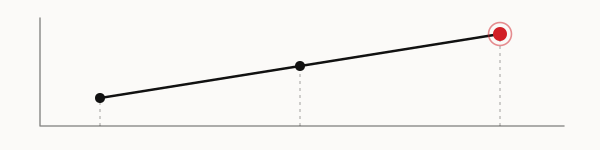
- T₀
The pre-format base; maturity and current practice go on record.
- T₁
Immediate change; the artifact produced and the maturity delta.
- T₂
Staying power; is the artifact still in use, is the slope positive.
The idea behind activation
Learning by doing.
What makes activation an established economic principle rather than a preference goes back a long way. In his 1962 paper on "learning by doing", Kenneth Arrow showed that most productivity growth comes from the production activity itself, not from capital or outside knowledge. Capability accrues by doing.
Ability is born of experience.
Arrow's observation is plain: learning happens during activity, while trying to solve a problem. Knowing is the start; doing settles the capability.
Not repetition; an evolving problem.
Repeating the same work meets diminishing returns; learning approaches an equilibrium and stops. That is why activation is not a single event but an evolving series: ideathon, hackathon, agentic jam.
Learning continues in use.
In the Horndal effect Arrow cites, a plant gained roughly two percent productivity a year for fifteen years with no new investment, on experience alone. Learning continues in use; AI Office Hours carries that continuity.
Underinvestment calls for a partner.
Arrow's critical finding is that the returns to learning are an externality; the market does not fully compensate them, and companies usually invest below the optimal level. Corporate AI adoption likewise calls for an adoption partner.
The same regularity shows up everywhere today: Wright's law in aviation, BCG's experience-curve strategy, solar panel and battery cost curves, and AI's scaling laws. They share a single intuition; doing produces ability, and cumulative experience turns into advantage.
Lokomotif AI's thesis sits in this language: AI capability does not come with a license purchase; it is a learning process that accrues through pilots, mistakes and every new tool that changes the environment. Activation is the name for placing that learning inside the company deliberately, measured and accelerated.
Source: Kenneth J. Arrow, "The Economic Implications of Learning by Doing", The Review of Economic Studies, 1962.
The most expensive step is starting in the wrong place.
In enterprise AI, most budgets evaporate on the wrong first step. The right starting point differs from company to company; a free 30-minute discovery call pins down yours.