We turned what the field taught us into a discipline.
For three years, across more than 100 companies, we have watched who creates value with AI and who stalls halfway. Our approach grew out of those observations.
Adoption starts in the control layer, not in operations.
CHRO38%CFO24%CEO22%CIO16%The role that initiates AI programs is usually the CHRO or the CFO; the CIO plays a supporting part. In Turkish enterprises, a significant share of the AI budget flows through HR and finance. A business-first adoption pattern, not IT-first.
The clear view of ROI emerges at T₃, not at T₁.
T₁ · end of program62%
T₃ · +180 days34%
A significant share of pilots that look positive in end-of-training satisfaction and T₁ measurement retreat six months later. Only T₃ validates the slope. Judging a pilot's success on the day it ends is statistically misleading.
Same use case, different stakeholders, different outcome.
Company A6 weeksCompany B9 monthsA customer-service chatbot reached production in six weeks at one company and was rejected after nine months at another. Same use case; same technology; the difference lay in the clarity of the stakeholder map. The hardest variable of adoption success to learn.
 Method
RTCS-G
We write the prompt library each role will use when working with AI, structured across the five layers of RTCS-G. The output: a company-specific, measurable, transferable decision discipline; the shift from individual talent to organizational capability.
Learn more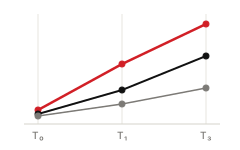 Capability measurement
AI Momentum
We measure every participant's AI capability across four components and three points in time. The output: a map that reads as a slope, showing where everyone in the company stands; real momentum, not end-of-training satisfaction.
Learn more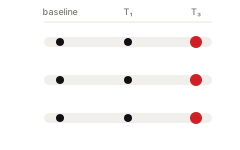 Measurement discipline
How we measure
We take baseline + T₁ + T₃ measurements across three layers: individual capability, workflow output and business outcome. The output: data that validates the program's ROI in the field; an evidence-backed answer to whether it is still positive after 90 days.
Learn more Engagement trajectory
Adoption Arc
We run adoption in three moves: Adoption Sprint, Workflow Rewire and Agentic Scale. The output: a staged shift from individual usage to agent-assisted operations; a new layer of capability stacked with every move.
Learn more Category manifesto
Manifesto
We write down how we see Corporate AI Adoption, where we part ways with the rest of the market, and the discipline we work with, in nine articles. The output: the operating frame underneath every program, tested in every engagement in the field.
Learn more
The most expensive step is starting in the wrong place.
In enterprise AI, most budgets evaporate on the wrong first step. The right starting point differs from company to company; a free 30-minute discovery call pins down yours.